Product Details
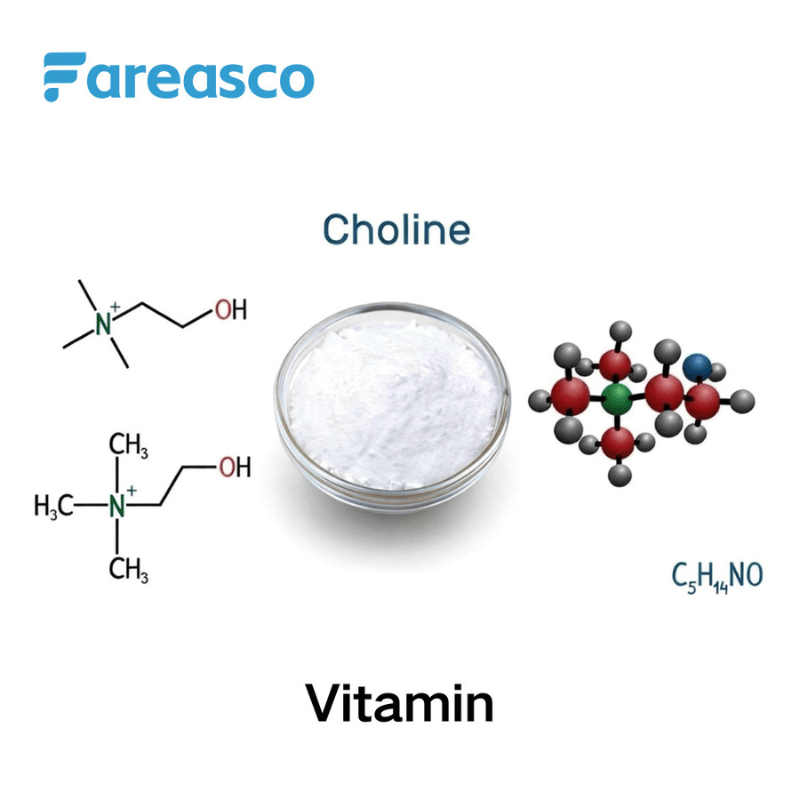
Choline chloride
- Choline Chloride 70% and 75% Liquid
- Choline Chloride 50%, 60%, 70% Corn Cob
- Choline Chloride 50% Silica
- Appearance:White Crystal Powder
- CAS No.:67-48-1
- EINECS No.:200-655-4
- MF (Molecular Formula): C₅H₁₄ClNO
Choline Chloride is an organic compound and a quaternary ammonium salt, classified as a B-complex vitamin (often referred to as Vitamin B4). It is an essential nutrient for animals and humans, playing a critical role in various metabolic processes. Chemically, it is represented as C₅H₁₄ClNO and appears as a white, hygroscopic crystalline powder. Due to its high solubility in water and stability in feed processing, it is most commonly produced and used as a feed additive in the form of choline chloride aqueous solution, powder on a carrier (e.g., corn cob or silica), or in pure crystalline form.
Choline chloride is the most common and economical form of choline supplementation because choline is naturally unstable and strongly hygroscopic, while the chloride salt form is stable, easy to handle, and safe for use in animal nutrition.
Choline chloride is widely used in livestock, poultry, aquaculture, and pet feeds. Its main functions include:
1. Animal Feed Additive (Primary Use)
Preventing Choline Deficiency: Prevents disorders such as fatty liver syndrome in poultry, perosis (slipped tendon) in broilers, and kidney necrosis in pigs.
Methyl Donor for Metabolism: Provides labile methyl groups for the synthesis of methionine, betaine, creatine, and other essential compounds, reducing the dietary requirement for methionine.
Fat Metabolism and Transport: Facilitates the synthesis of phospholipids (e.g., lecithin), which are necessary for transporting fats from the liver. This prevents abnormal accumulation of fat in the liver (hepatic lipidosis).
Cell Membrane Structure: As a component of phosphatidylcholine, it maintains the integrity and fluidity of cell membranes.
Nerve Function: As a precursor of the neurotransmitter acetylcholine, it supports nerve impulse transmission, muscle movement, and brain development.
Growth Performance: Improves feed conversion rate (FCR), daily weight gain, egg production in laying hens, and survival rates in young animals.
2. Industrial and Chemical Applications
Oil and Gas Drilling: Used as a nontoxic, biodegradable clay stabilizer in drilling fluids to prevent swelling and disintegration of reactive shales.
Photographic Industry: Employed as a stabilizer in photographic film processing.
Organic Synthesis: Serves as an intermediate in the synthesis of other quaternary ammonium compounds and specialty chemicals.
Packing: 25 kg/carton
Shelf Life: 2 years